STAY
About the exhibition
Sitting is an everyday act, and at the same time a cultural activity. Seating structures spaces, defines postures, encourages you to stay a while, or signals distance. The exhibition “STAY – Textile Seating Items” is dedicated to sitting and presents experimental designs by students from the Department of Textile Product Design at Kunsthochschule Kassel led by Prof. Ayzit Bostan.
The project centers on the textile seat as an independent design element. Textile materials possess special properties: They respond to the body and to movement, create atmosphere, convey proximity, comfort, or tension. Over and above their pure function, they can have an emotional, spatial, and aesthetic effect. These potentials form the starting point of design work.
The students have closely examined historical and contemporary seating items from Die Neue Sammlung’s collection. These objects have served them not as role models in the classical sense but as points of reference and as stimuli for their own approaches. What role does material play in relation to the body? How does the structure, surface, and textile technology change our perception of sitting? And how can we think of new forms of using seating?
The design process included researching materials and techniques, conceptual experiments, and developing and realizing prototypes. The outcome were seating items made of a variety of materials, such as felt, leather, and metal.
STAY is presenting these pieces in the X-D-E-P-O-T by way of a snapshot of an open design process. The exhibition offers us an opportunity to see how young designers bring curiosity, precision, and a zest for experimentation to bear in renegotiating the relationship between body, material, and space – and reveals seating to be something that goes far beyond merely taking your place.
Regular cooperation with education institutes such as academies and universities is a core part of Die Neue Sammlung’s mission. For Die Neue Sammlung seeks to support the discourse on current topics and content with students in practice, too, and render it accessible to the museum’s visitors.
Ayzit Bostan is a designer and artist and lives in Munich. Since 2012, she has been Professor of Textile Product Design at Kunsthochschule Kassel. In 2023, Ayzit Bostan was awarded the “State Capital of Munich’s Design Prize”.
Students:
Helena Bals, Zoe Debik, Matilda Elisabeth Grams, Tim Felix Kostka, Tatjana Kovbasa, Felix Leiffer, Indira Maruki , Carolina Moisei, Silas Vogler, Linjun Zeng
Designs & Prototypes
-
Exhibition view “Stay”, Die Neue Sammlung – The Design MuseumPhoto: Die Neue Sammlung, Kai Mewes
-
Felix Leiffer. SECOND JUMP, 2026. Material: steel spring, South German merino wool, wood, foam.Photo: Jasmin Minne
-
Tim Felix Kostka. L1 Lounge Chair, 2026. Material: stainless steel and nylon webbing, hand-woven.Photo: Fabian Frinzel
-
Indira Marukić. LAMETTA, 2026. Material: lamb nappa, wood, PLA.Photo: Jasmin Minne
-
Zoë Debik. PÄRLE, 2026. Material: ripstop, cotton fabric, EPS beads, wire rope.Photo: Fabian Frinzel
-
Linjun Zeng. Dé, 2026. 100% Wool, polypropylene.Photo: Jasmin Minne
-
Linjun Zeng. Dé, 2026. 100% Wool, polypropylene.Photo: Fabian Frinzel
-
Carolina Moisei. OVERRED, 2026. Material: Eigengut® 100% wool, wool felt.Photo: Fabian Frinzel
-
Silas Vogler. TRANSIT, 2026. Foam padding (PU foam), various textile covers.Photo: Jasmin Minne
-
Matilda Elisabeth Grams. MIKADO, 2026. Material: stainless steel, polyamide.Photo: Jasmin Minne
-
Helena Bals. FARFALLA, 2026. Material: 100% ocean-bound polyester, BioFoam beads, stainless steel.Photo: Jasmin Minne
-
Tatjana Kovbasa. OPORA, 2026. Material: wool, stainless steel, foam.Photo: Jasmin Minne
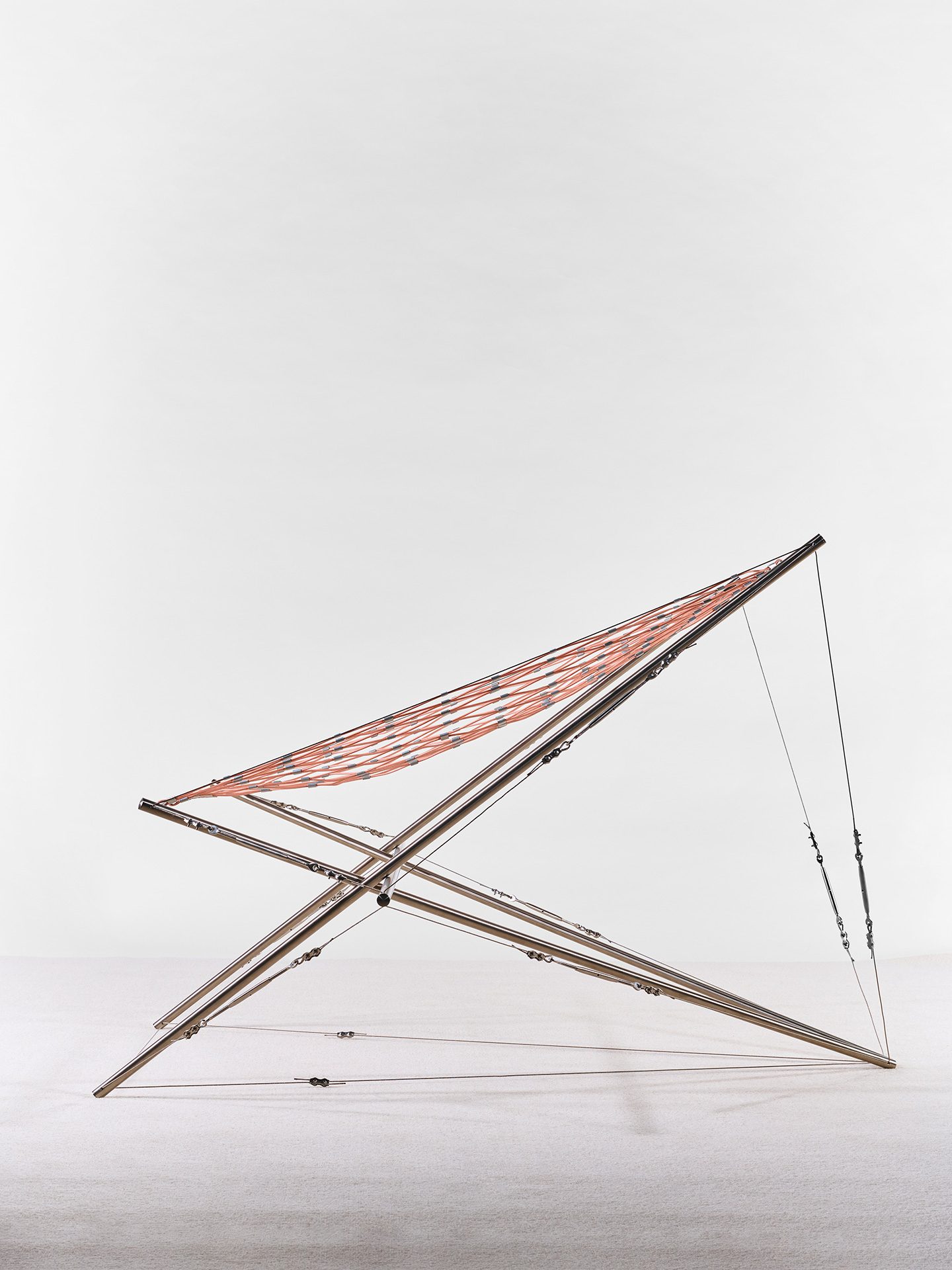
MIKADO transposes architectural and sculptural design methods onto a homely piece of furniture. Its Tensegrity structure consisting of five stainless steel tubes and metal wires delivers stability solely through the tensioning. The armchair with its textile weave has a light, minimalist, and floating appearance. Thanks to a special mechanism it can be folded absolutely flat for transportation and in so doing becomes almost a two-dimensional object.
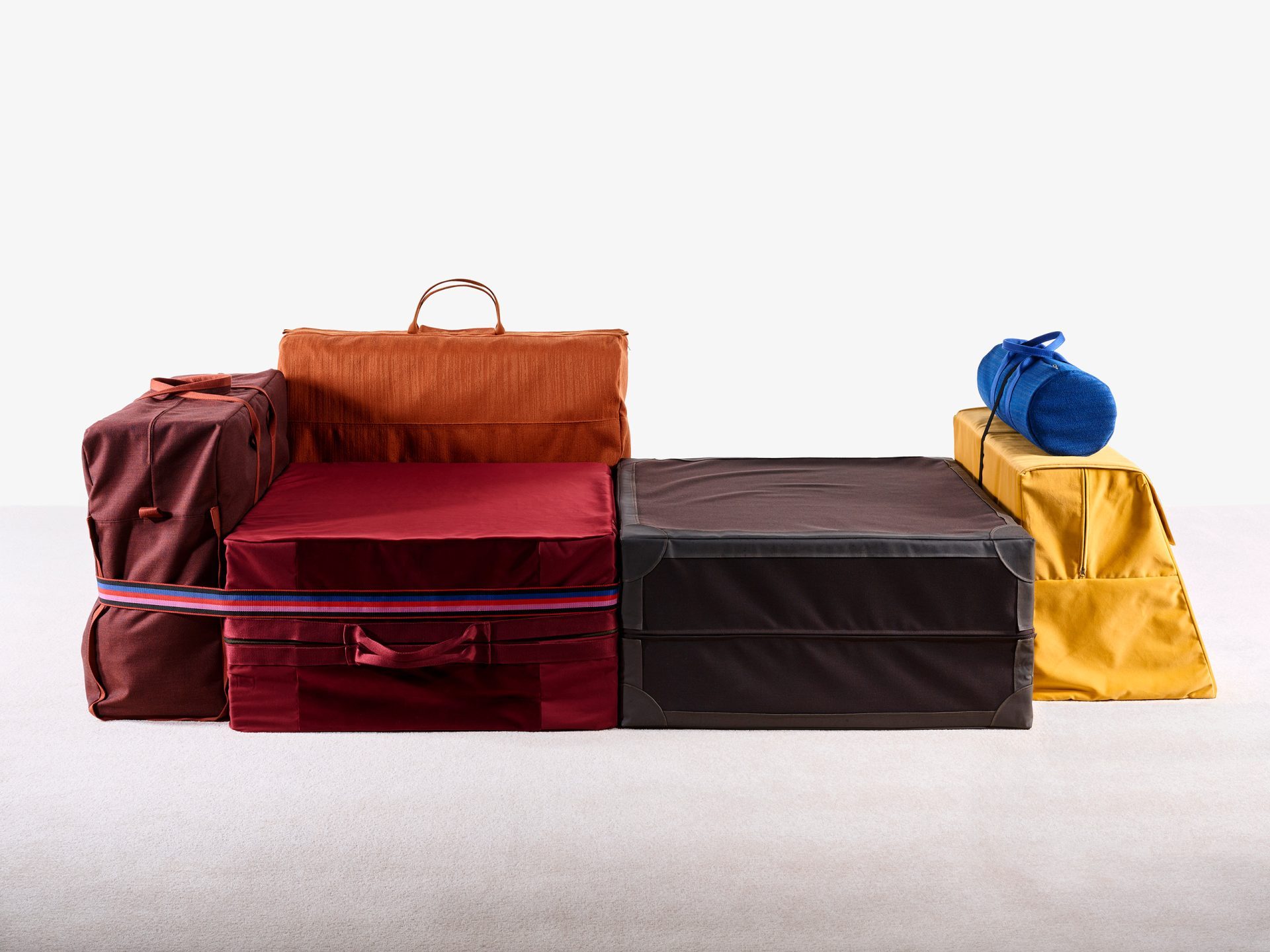
The TRANSIT object translates informal moments of travel into a designed seat: sitting on a suitcase, relaxing while waiting. Modular in structure, it oscillates between mobility and tranquility, and reflects on the relationship between body, luggage, and transition.
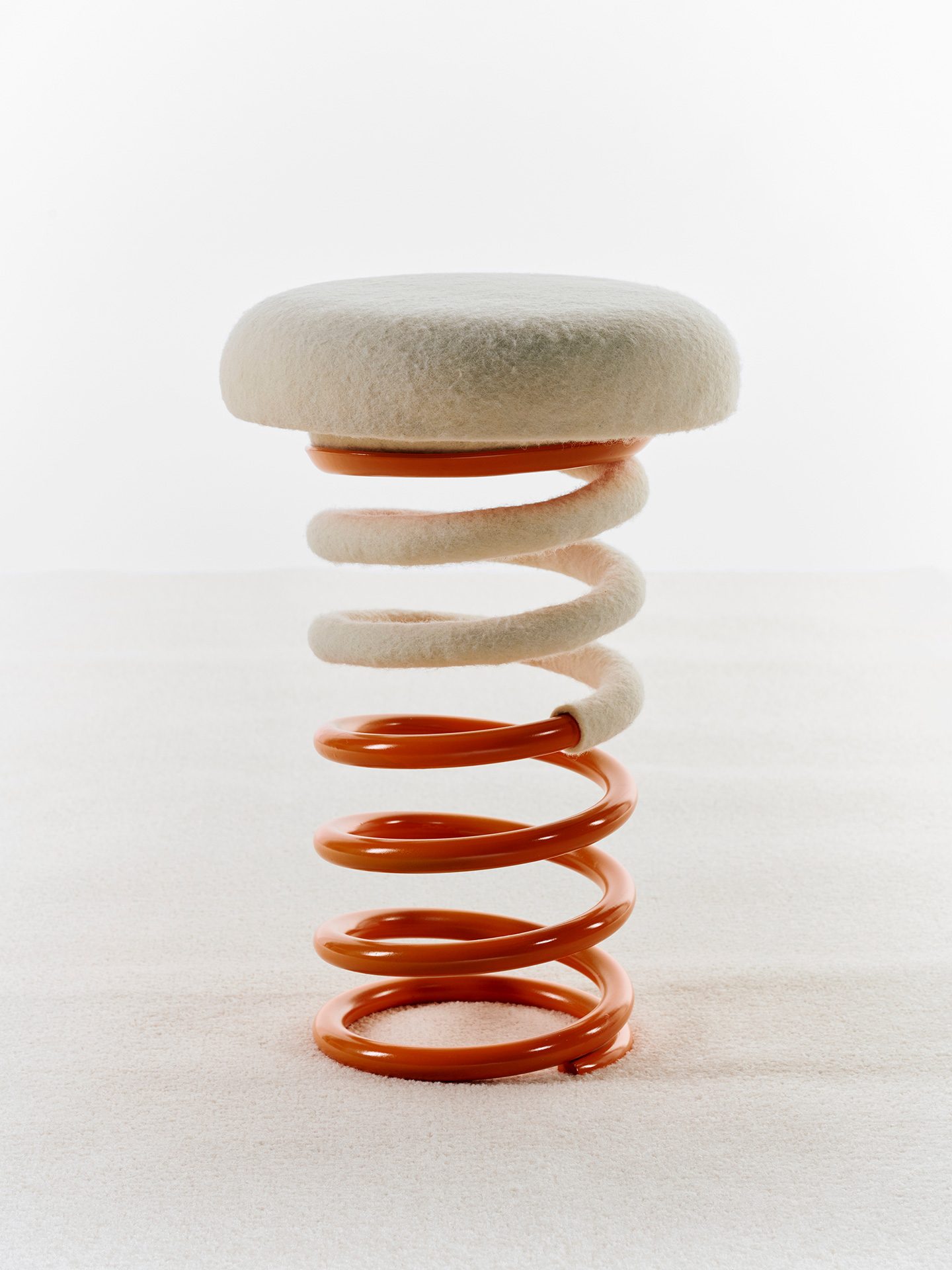
The SECOND JUMP mini-series focuses on the topic of material cycles and sparing resources. A used spring from a playground is combined here with a seat made of regional merino wool. Two contrasting materials unite to form a new entity.
Sheep’s wool is often a waste byproduct but in this design thanks to the wet felt technique gains a new lease of life. Its positive properties (warmth, cushioning, and texture) are visualized in the process. While highly stable, the integrated spring allows you to sway slightly. Movement becomes part of the sitting posture.
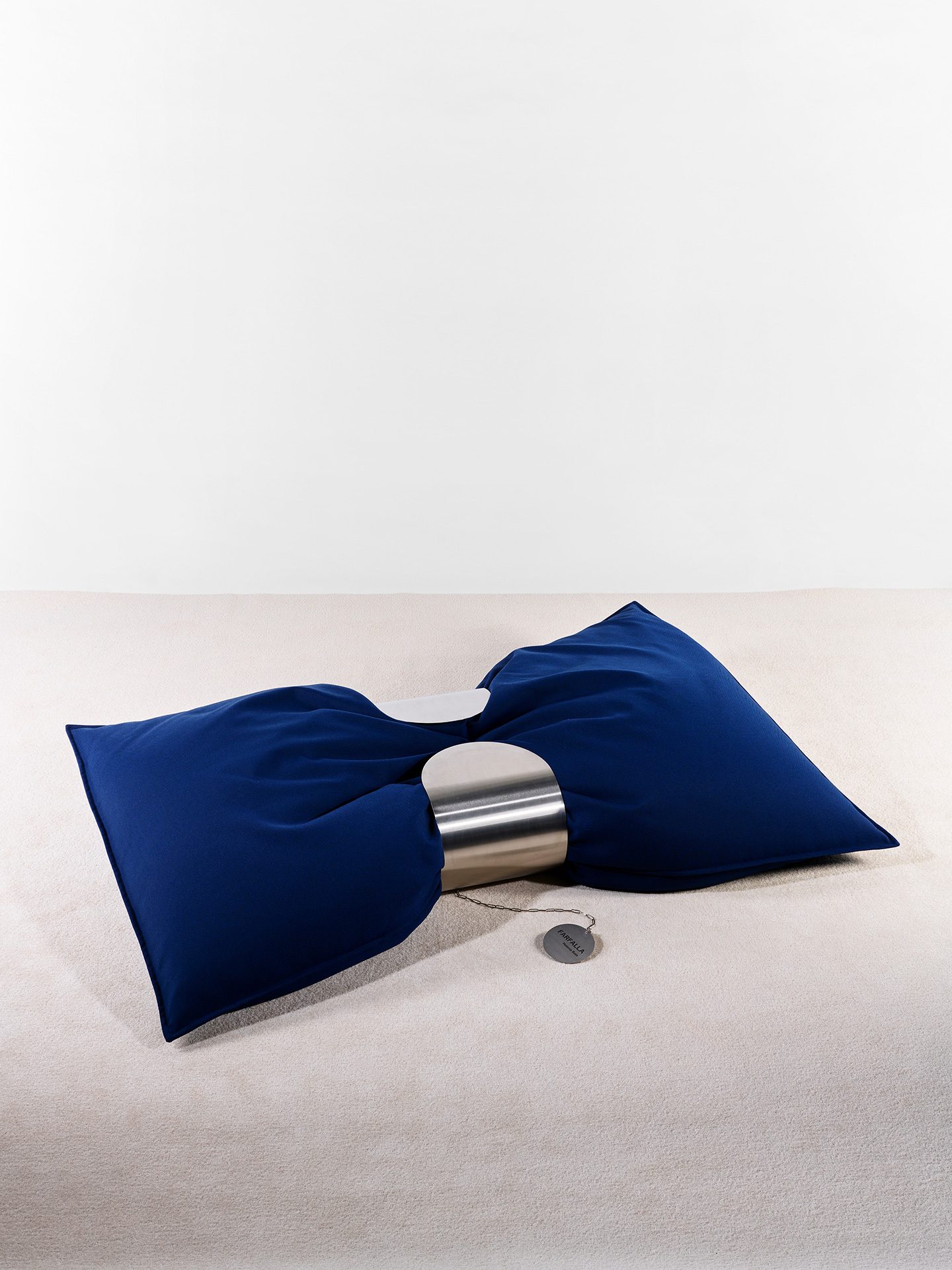
FARFALLA is a new interpretation of the floor cushion. An enlarged bracelet morphs from jewelry item into a structural element and connects the cushion to a side-table. The ring-shaped structure creates a rest top and also tension – the controlled crushing shapes the volume and the silhouette. The element remains movable and can be used depending on the situation: on your own, for two of you, and flexibly within the room.
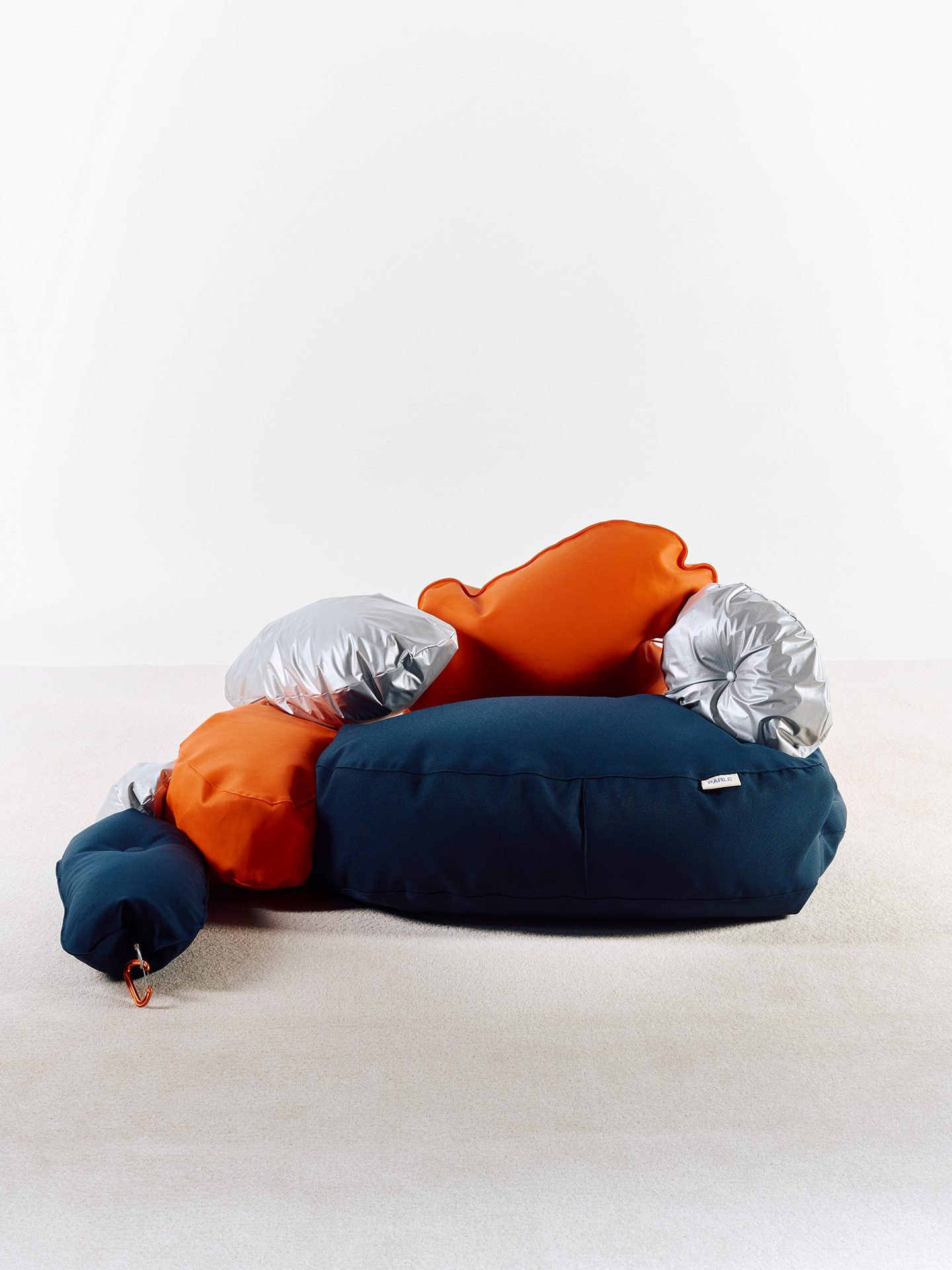
The PÄRLE prototype represents a scaled chain of beads, whereby the row of upholstery flexibly adapts to the body. Seat and user engage in a natural dialog. It is a vibrant piece of furniture that refuses to view sitting as something static.
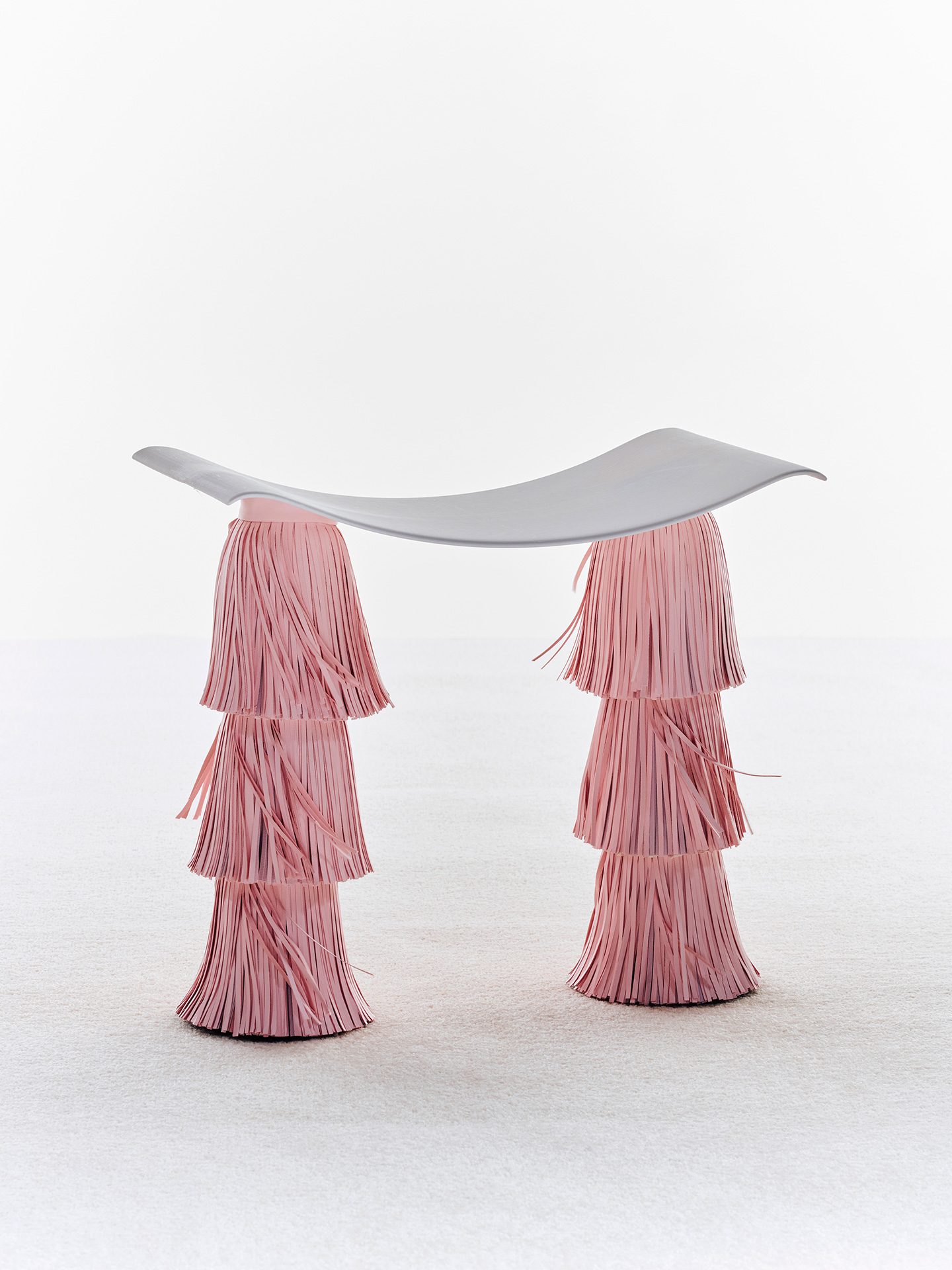
The LAMETTA stool is an homage to Roman design elements; in a reduced idiom, it emulates the curved shapes of Roman chairs. The legs are clad in thick leather tassels and reference Roman helmets, which were adorned with horsehairs, while also playfully complementing the lightness of the seat. LAMETTA can be used as a stool or as a valet stand, drawing attention to the preservation of our cultural heritage.
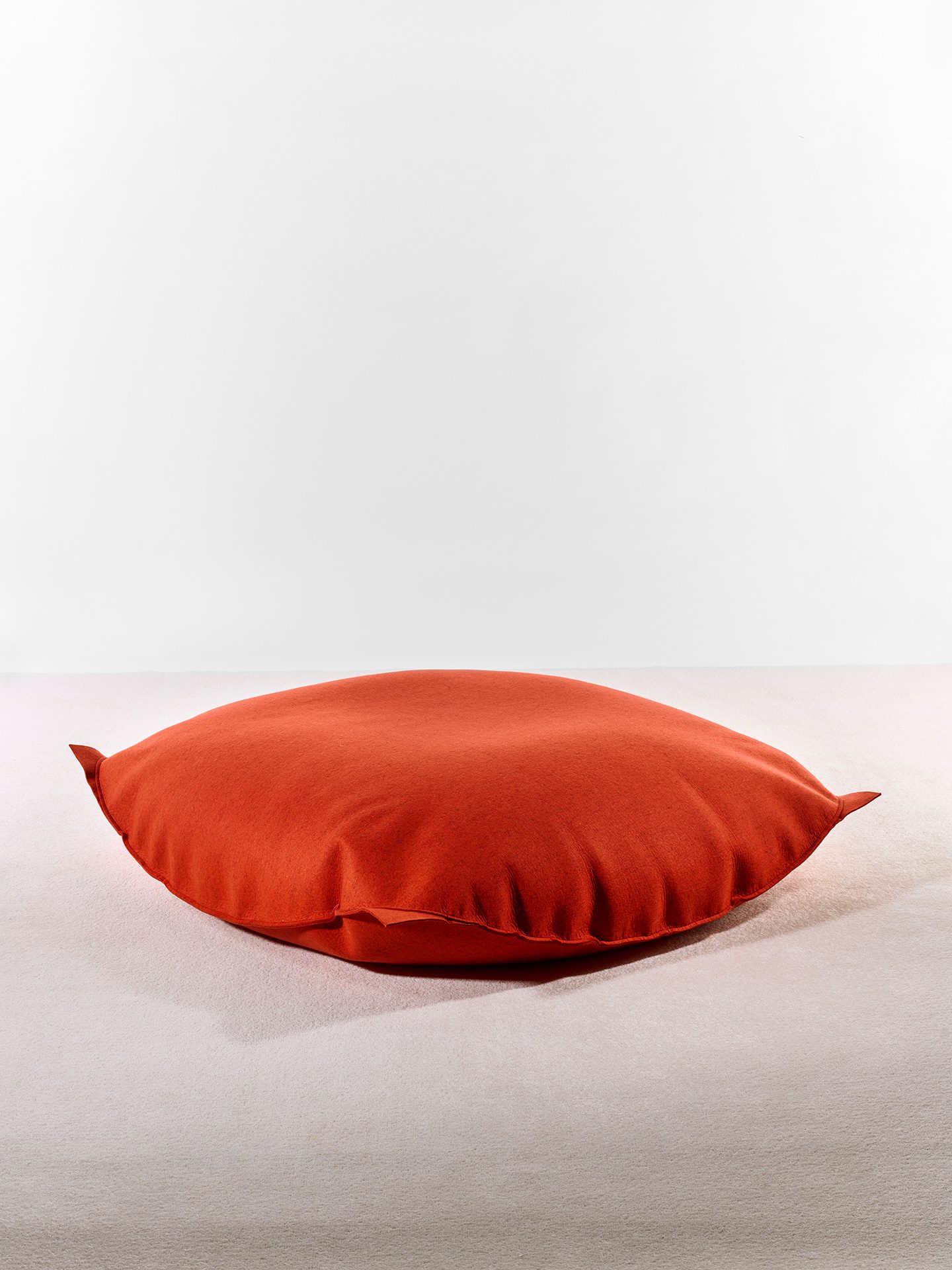
OVERRED is a textile item devised as an experimental object and is based on merging two different geometric shapes. It critically examines the relationships between shape, body, and function. It obeys no clear ergonomic definition, and its use is therefore left open. Volume, edges, and the way the material behaves also respond to the body, encouraging you to interact with it physically. Function and meaning first arise when it is used.

DÉ – Drapé for a chair. By virtue of the woolen fabric being draped, the hard, industrial lines are replaced by a softer silhouette that snuggles up to the user. The chair is infused with volume, weight, and presence. The wool offers warmth, a pleasant activity, and a sense of closeness. Starting from the interface between artisanship and industrial design, Dé explores the status of mass products. The textile envelope functions as protection, surface, and identity marker for a standard
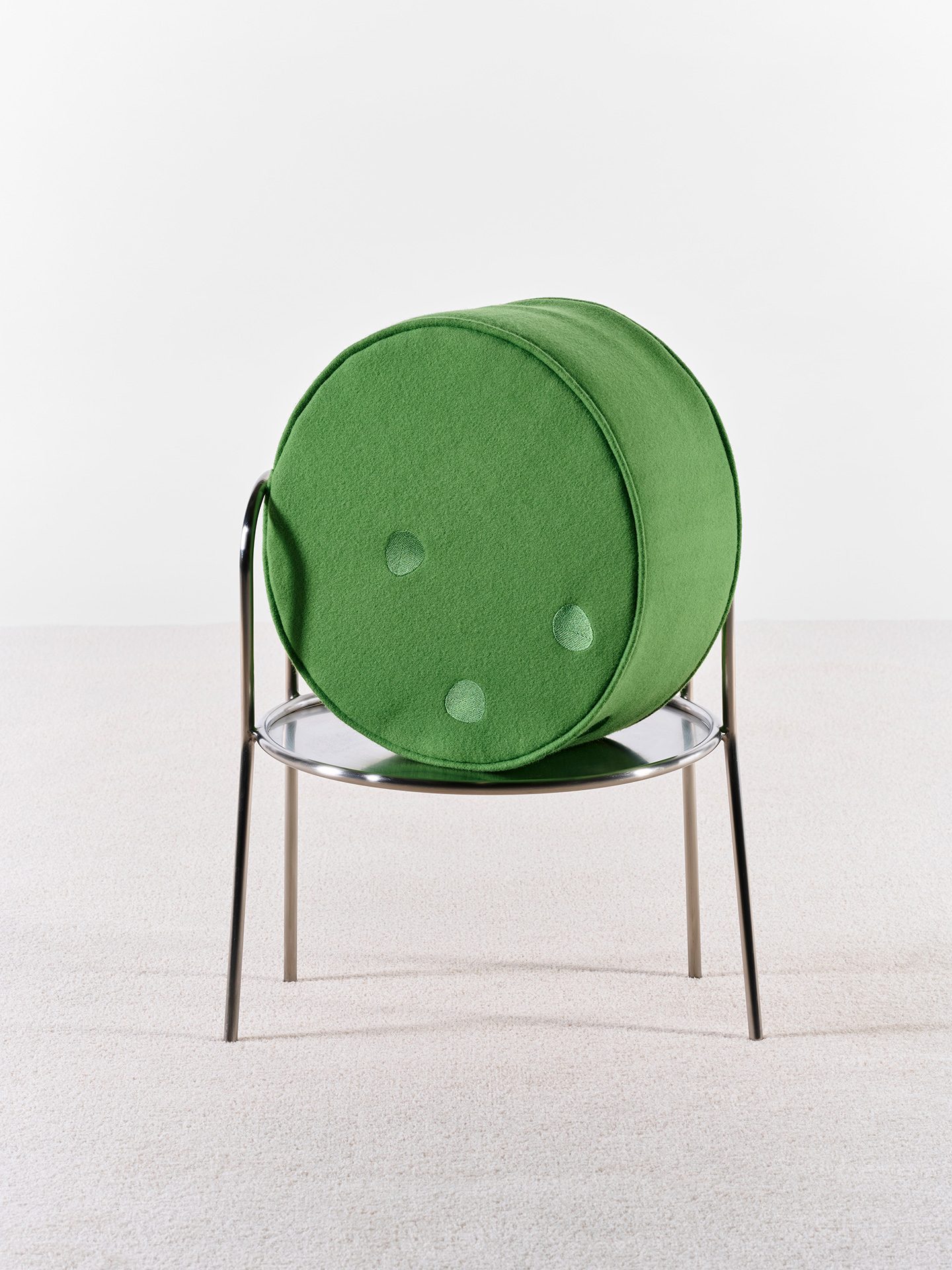
OPORA is a stool with a clear load-bearing structure. Its shape quotes the frame of the AEG no. 60h water boiler and transposes an historical industrial object into a contemporary context. Curved stainless steel arches bear the fabric seat and double up as handles. The structure and use thus merge. The clean lines underscore the shape’s industrial feel.
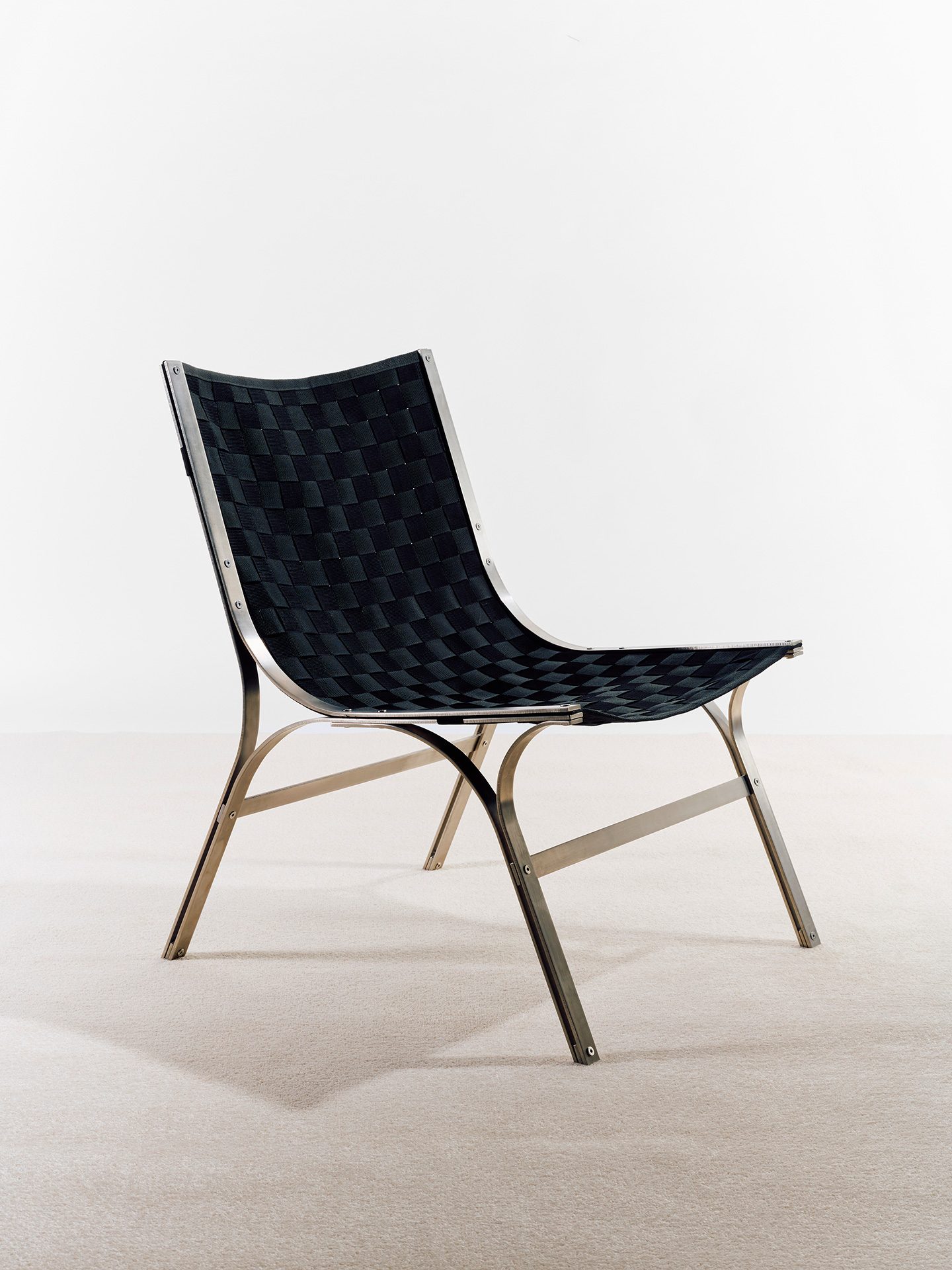
The L1 LOUNGE CHAIR examines the relationship between mass and lightness. Heavy materiality combines here with elegant shapes. Precisely positioned connecting points reduce the material inputs required to a minimum while symbolizing a sustainable approach that spares resources. The textile seat can be swapped and functions as a modular element, allowing colors, textures, and personal user contexts to be adapted at will.
Plan a visit
Where?
-
Barer Straße 40, 80333 Munich
Opening hours:
-
Daily 10:00 – 18:00
-
Monday closed
-
Thursday 10:00 – 20:00
FAQs
-
Curated by:
Polina Gedova, Angelika Nollert
-